Saturday, September 28, 2013

Today in the garden: late summer dahlias, asters and ... voles!

This is the time of year when the sounds in the garden are the most delicious and haunting. It rained overnight, and this morning, now, early, there is a soft buzzing everywhere overhead. The thready song of first fall.


And there is anticipation. Anticipation of bulbs arriving to be planted in the ground, to snug down for the long winter and then gradually, slowly awake to spring. And beds to be put to rest. Plants to be taken up, mulch to be put down, last weeds to be weeded.

And voles. Nasty voles have invaded my garden this summer. It seems the twin combination of lots of bird seed and nice, new plants with freshly dug dirt are just too irresistible for voles. I've got new vole holes popping up every other day. Holes in the back garden. Holes under the hosta. Holes in the yard. Holes under the front porch. Holes in the front garden. I won't bore you with photos of holes, but I may talk about dealing with them, if I can manage to find a solution.

First order of business? I have stopped feeding the birds for the moment. A difficult but necessary step.

But the garden is still pretty, even in its last blush of late summer. Tomatoes galore for us and for the neighbors.


Marigolds, at the peak, giants this year, amazing, impossibly giant giants sweeping up along the road in glorious clouds of orange and red ...


Asters, at their peak ...


Dahlias ...


Zinnias ...


The happy, leggy bonariensis that I never thought would come up from seed ...


A rambunctious late volunteer nasturtium setting off the heaven's gate coreopsis ...


The porch in its hanging pots aglow ...


Dogwood, yew and holly getting their fall reds out of storage ...


Fall geraniums with happy faces ...


One last rose ..


And one last nameless weed blooming ...


Cats in sunny windows on cold mornings ...


Spiders, big as science fiction monsters, readying their Hallowe'en webs (ancient shovels repurposed out of the lost depths of the garage to gently sweep them away from doorways back into the garden) ...


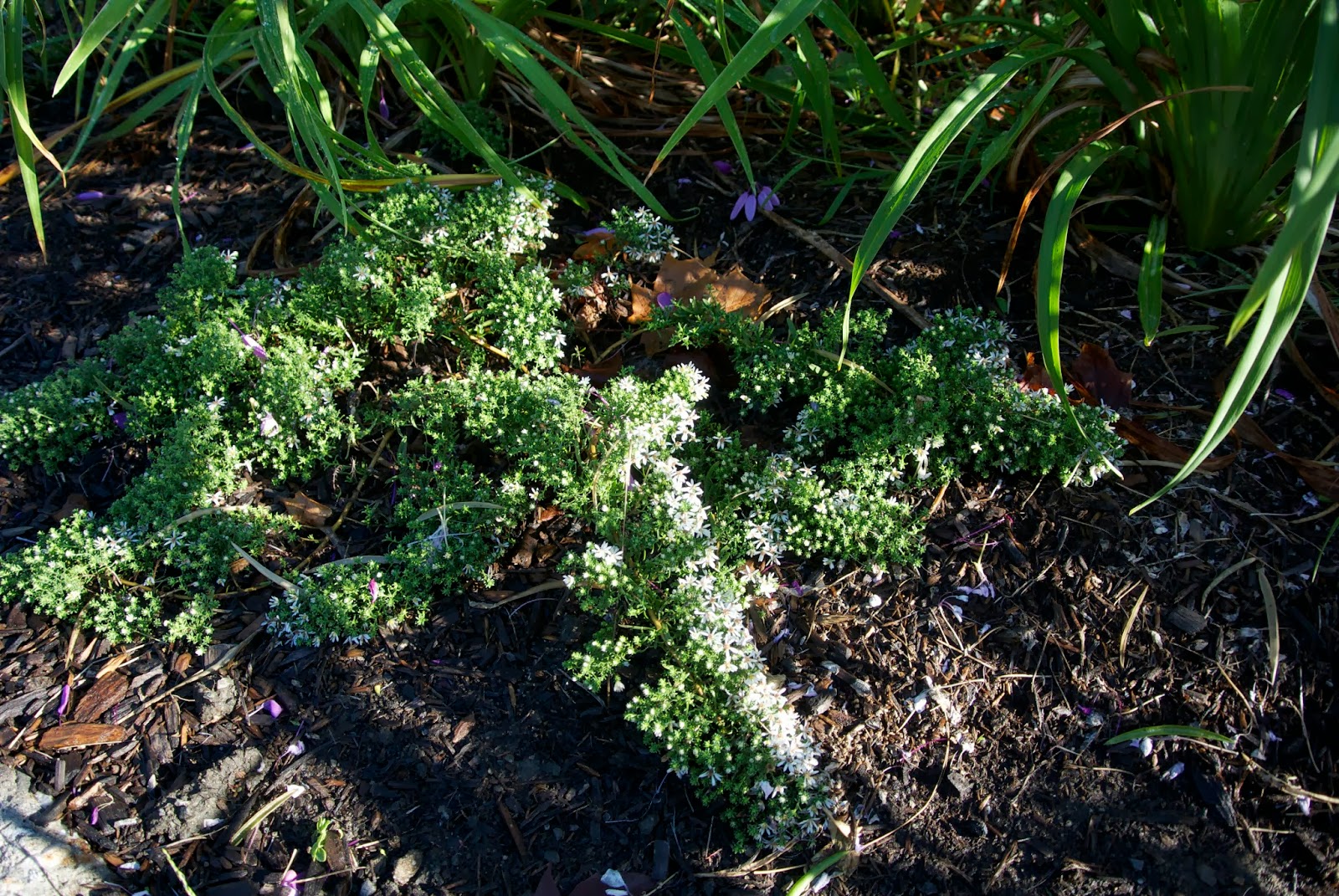
And the Hardy Cape Daisy, freed from bittersweet in the longago spring (here) and long anticipated, now finally in bloom ...


Friday, September 27, 2013

Where did the well come from? Comparing earlier photos of Pugsley's southeast corner

I've been doing a repair on the southeast corner of the house, which has sustained a bit of moisture damage from the downspout on that corner. Last week, we had new gutters and downspouts installed, and rerouted the downspout away from that corner entirely, because there is an old well up against the house, with a slight hill next to it that brings the level of the ground right up near the siding of the studio addition on the back of the house and just creates a difficult drainage problem no matter how good the downspout is. 

Here's a close-up of the well and garden around it. 


I remembered seeing a photo of the well from an earlier period when a tree was there, and went hunting  up old photos of that corner of the house. Here's the well with the tree. This kind of square photo with rounded corners is probably 1970's vintage or so.


And I, of course, along with everyone else, has assumed that the well was there before the house, or is at least contemporary with the house and dug before the studio addition, because it is smack up against the addition -- not an ideal location.

But, lo and behold, in a photo that looks to date from the early 20th century, there appears to be no well! Is there a well there without the two-foot high stone wall or curb around it? I really can't tell.


Just for comparison purposes, here is an even earlier photo, from a time before the road along the south side of the house was there, or perhaps the road is there but not paved. Unfortunately, the angle is such that you can't see the well area.


And, here we are again today. Well, did that well come from? Another Pugsley mystery.


Sunday, September 8, 2013

Underneath its skin: Pugsley re-siding in 1963

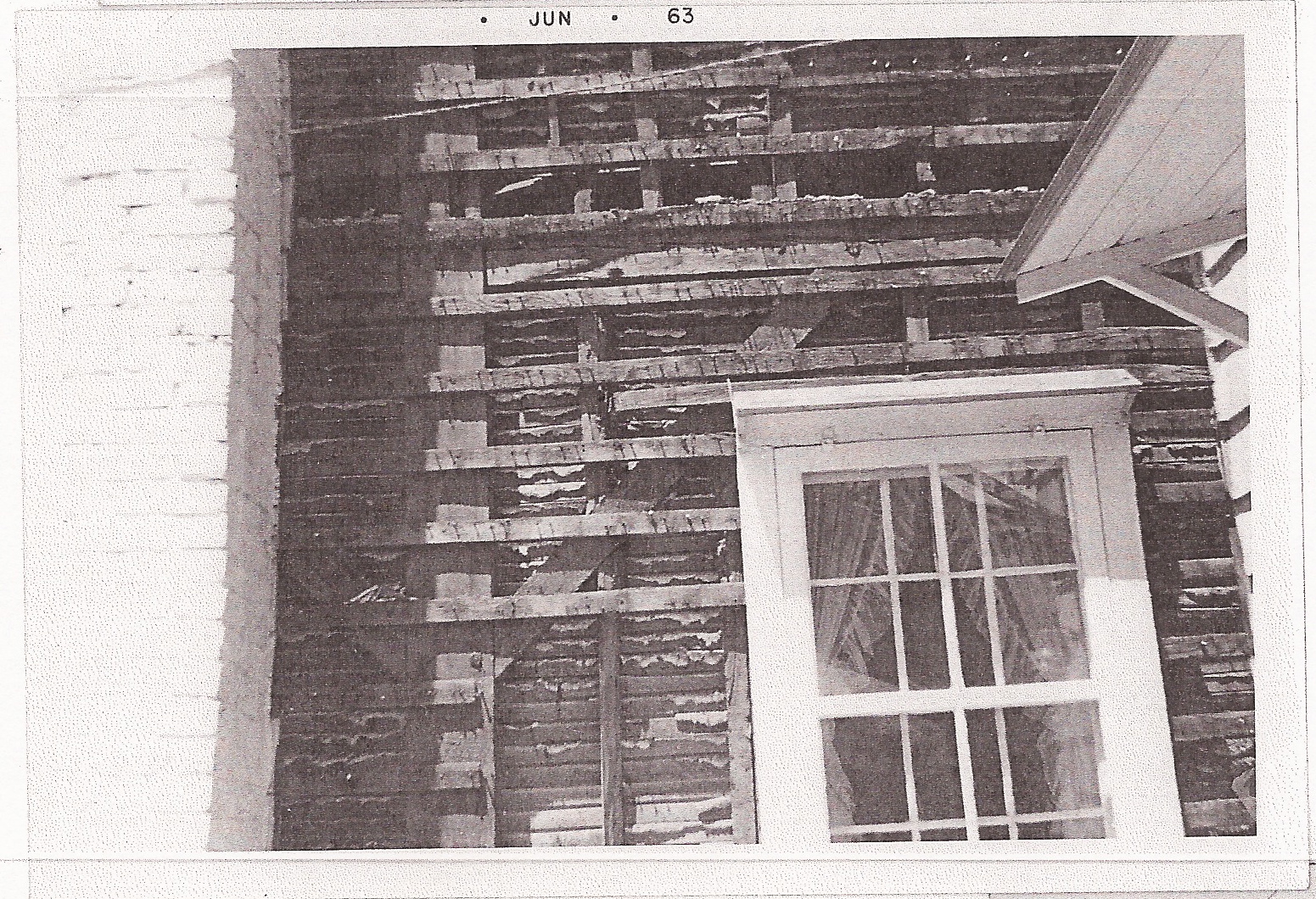
I'm working on my first siding project, a very small repair of one tiny corner of the house. And in trying to understand the construction, I went digging around in photos the former owners left. These photos below are a little grainy, because I am working from xeroxed copies, but they're still very interesting. These are photos from June of 1963 (the month I was born), when the house was last sided. 

The photos illustrate two important factors of the older construction methods used on this house.

First, the house has a kind of "skip-sheathing" underneath the cedar shingle siding -- little strips of 1x2 furring or nailers in horizontal lines, that the shingle siding is nailed to. Here are two photos of the back of the house, showing the skip-sheathing clearly.


This creates an airspace between the lathe and plaster wall and the shingle siding, which lets the house breathe. I think it is an important component of the longevity of this house. Here is an article that explains, in somewhat more technical terms, why.

Two, in places the house has two layers of siding. Here below, you can see the new siding being nailed on top the old. 


The house is unusually airtight and energy efficient for an old house, and I think both of these things contribute to it, as well as the thick plaster walls, the 1830's window construction made without pulleys and ropes, and the storm windows on top of that. 

We had an energy assessment the first winter we were in the house--one of those free ones that companies offer, to sell you things like blown-in insulation, re-siding and replacement windows--, and the guy kept wandering about all confused because he couldn't find any major temperature variations at the window trim or electrical outlets. All houses have little draughts, he kept saying. Ours doesn't. He couldn't find anything to suggest, not even window replacement.

And yet, there is no foam insulation or wrapper, nothing "artificial". No modern materials. I'm not one to valorize older materials simply because they're older, but I do feel that old house building methods have stood the test of time, are proven to last and are worth taking the time to understand and replicate when repairing an old house.


Saturday, September 7, 2013

Where has all the crabgrass gone? Update on eliminating crabgrass from the patio

It's only been a month since my last update, but I am very happy to report total SUCCESS on one of my many ventures this summer. There is no crabgrass on the patio. Where has all the crabgrass gone? You may ask yourself.

Into this bucket!


This was the last of it. And believe me there were many such buckets all summer long. This last one was captured on August 15 and I am pleased to report that today, September 7, 3 weeks and 2 days later, there is still no crabgrass. I have gotten out ahead of it -- for about 3 minutes.

You can track the allies who came to my aid on the various posts on this topic under the topic "patio crabgrass" to the right of the home page. But a picture is worth a thousand words they say, and here are the photos.

Patio back to front and side to side, this past weekend:


Close-up of the worst side:


You can clearly see that there are indeed other weeds on the patio, such as this interesting creature:


The friendly weeds are a part of the defensive strategy and except for a few clover are much easier to root out than crabgrass. I also have "friendly fire," so to speak, in the form of several different types of thyme. Here is how they have fared.

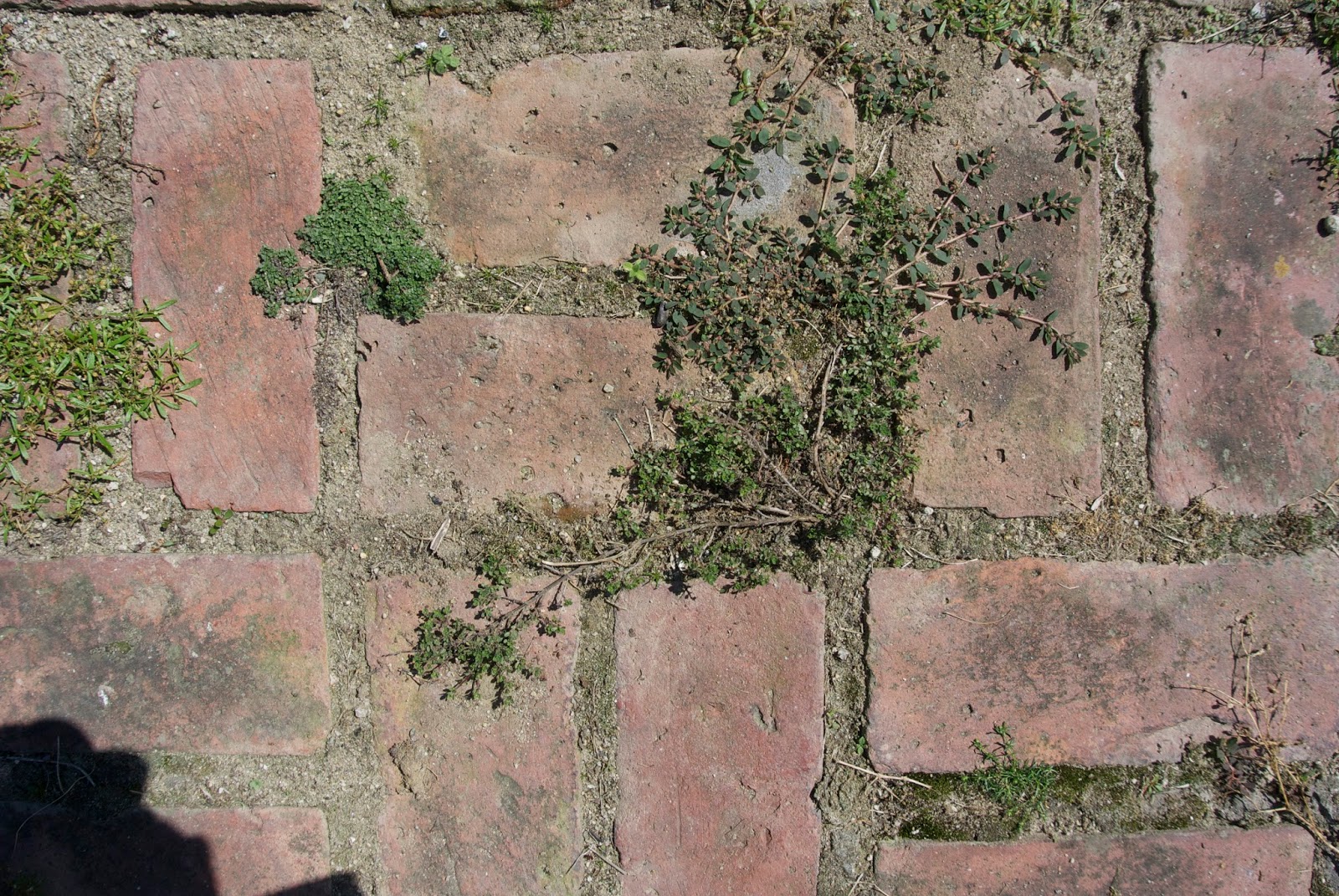
Creeping thyme, which went in last September. The difference between its growing over bricks and between bricks seems to be light foot traffic. A bit of foot traffic seems to confine it to the places where it is rooted. Not totally sure, because these bits don't get much foot traffic.


Wooly thyme, planted this June or so. So far, the tendency of this one is to mound up into a circle, rather than creeping along between bricks. I haven't  made up my mind about this one.


Pink chintz thyme, just planted a few months ago. This spreads very rapidly with long runners. You can see them in the second photo. It also blooms in late summer (rather than early summer like the rest). It's pretty and a welcome addition.


Mint thyme. These were planted about this time last year. This mounds, too, and so far most of what I've planted has not really put out shoots along the nearby cracks, though you can see in the lower photo a mint thyme that is starting to grow out perpendicular fashion. Also, it tends to die out easily from the center when it is too dry or gets foot traffic, so the jury is out on this one too.


Minus thyme. People say this is a low grower, but the bit I planted has mounded. Jury is still out on this one.


This photo shows two types growing in two different ways -- I really don't know which variety either of these are. Ultimately, part of my thought is just to introduce enough diversity that the patio gets populated by thyme, period, rather than crabgrass.


And, the winner by far: elfin thyme. This confines itself to the cracks between the bricks and tolerates heavy foot traffic. The one drawback, it grows unbelievably slowly. These bits have been in place for more than a year.  So they're not much competition for the crabgrass, and won't be for a long while, most likely. Still, I have decided, when I get the time, to order plugs of this variety and plant them all over the entire  patio and let it take its time to fill in.


Finally, for wet and shady spots, this little creature named Corsican Mint (a mint, not a thyme) is settling in quite nicely. It dies back anywhere there is too much sun or not enough moisture, but in several shady, protected areas of the patio it has not only survived the month-long drought of July, but even prospered. The only hesitation is that some of my research indicated it might be an aggressive grower, like all mints, and so I am waiting to see whether it is able to co-exist nicely with my other shade denizens or not.