Showing posts with label thumb latches. Show all posts

Friday, July 12, 2013

More old doors: 1830's interior four-panel doors

One of my readers asked for photos of whole interior doors in the house, to help with the restoration of another 1830's home. So, here they are along with a tiny bit of research on door width.

Nearly all of the doors inside Pugsley are of the exact same construction: four-panel wood doors ranging from 1-1/8" to 1-1/4" in width. One side is trimmed out with a nice trim around the panels, usually the side facing out of the room. So, for example, here are two bedroom doors in the upstairs, both of these shots are taken from the hallway side.


By contrast, the inside of the doors is more plain, with no trim around the panels. This is the side that when swung open would face the wall and not be visible anyway, unless one closes the door and looks at it from inside the room.


And, finally, they are all equally thin and all have thumb latches, rather than door handles, as I have discussed exhaustively on other posts here and here (or you can view all by going to the topic "Thumb Latches" in the topics list on the right hand side of the home page). Here, for purposes of illustration is a side shot of the door shown immediately above:


Doors this old are apparently thinner than later 19th century doors, and due to the thinness of the door cannot take a door knob assembly. I don't know why that might have been the case, but I had seen it mentioned a number of times in various places and have also verified it in an article on the history of door knobs and locks in Antiquehomesmagazine.com, titled "The American Doorknob," which you can find in its entirety here.

As you can see from this quote, interior residential doors were generally thin in U.S. construction until the 1840's, with some thicker doors being found in 1820's and 1830's homes.

Mortise locks had been made in England since around 1790, but were not largely used in America until 1840s. This was due to the narrow thickness of the doors in the majority of Colonial period houses. Being 1¼” or less, the doors could not be cut out or mortised to accept such locks. These thin doors were usually equipped either with surface mounted thumb latches, spring latches, or rim locks. Then during the1820s/30s, common interior doors started to become thicker (1½”, 1¾”, 2"), which allowed them to accommodate a mortise lock or latch. 

Thank you to the reader who asked for this info, as this is another piece of evidence dating our house to the 1830's. If more specific close-up detail is needed, please just ask!


Friday, May 24, 2013

Basement thumb latch

Here's another in the series on thumb latches. This one is a door in the basement. An amazingly beautiful door, I think. I don't think it needs much explanation. For photos of other doors in the house with different styles of thumb latches, see "Thumb latches" in the list of Topics to the right on my home page.


Tuesday, May 14, 2013

Blake Style Thumb Latch Hardware: Interior Door Installation and Latch Bar, Catch or Keeper Fixes

Hits continue apace on my two posts on thumb latches, which you can find by clicking on the "thumb latch" category along the righthand side of the home page under Topics. Today, I am making a third post on the topic, showing two things at once:  1) how a thumb latch is installed on an interior door, and 2) how a thumb latch can be tinkered with if it is not catching or latching properly.

Fair warning that I did not install or tinker with this latch. It seems to have been repaired a couple of times, but prior to me. In my mind's eye, I see Martin, the previous owner, up here with his ball peen hammer, sinking in a little silver nail to help the latch latch.

This is called a Blake style thumb latch, which according to Ed Donaldson Hardware Restorations,

were manufactured by most of the major hardware manufacturers for many years. Patented in 1842 -- this type of thumb latch could still be found in some form in catalogs for about 100 years.

In any case, without more ado, here is the outside of one of the bedroom doors upstairs ...


Close-up of the thumb-latch handle from the outside:


Now, close-up of the handle and the latching mechanism on the edge of the door ...


That mechanism is inset into the edge of the door, like so ...


Here are a few more clear views ...


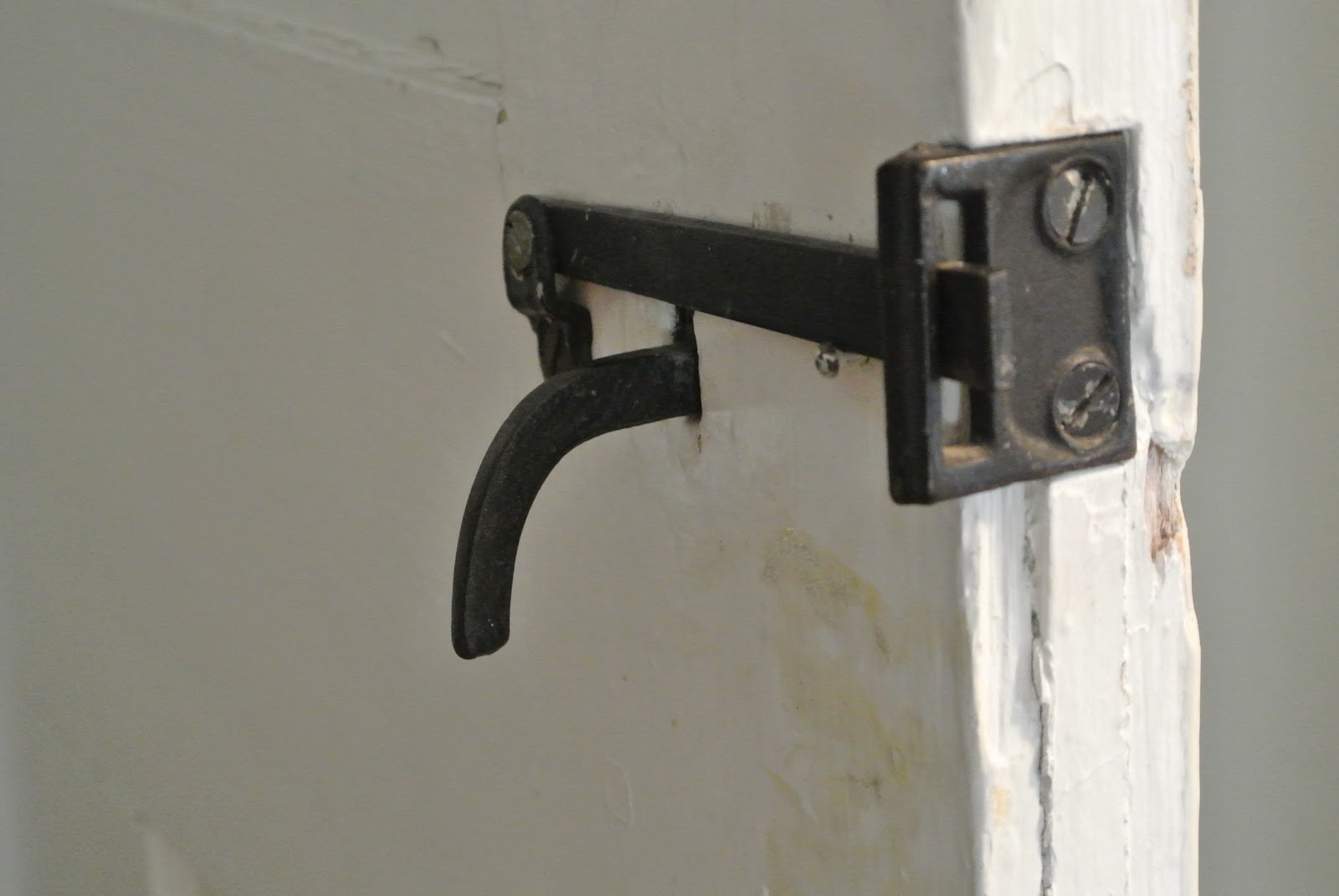
Here's where the repair comes in. You see a small nail underneath the latch bar, keeping the latch bar high enough so that when it is pulled closed, the latch comes up and over the hook or catch or keeper on the doorframe.


Here's another view:


If the  nail wasn't there, the latch would stick under the keeper, rather than being in position to slide up and over ...


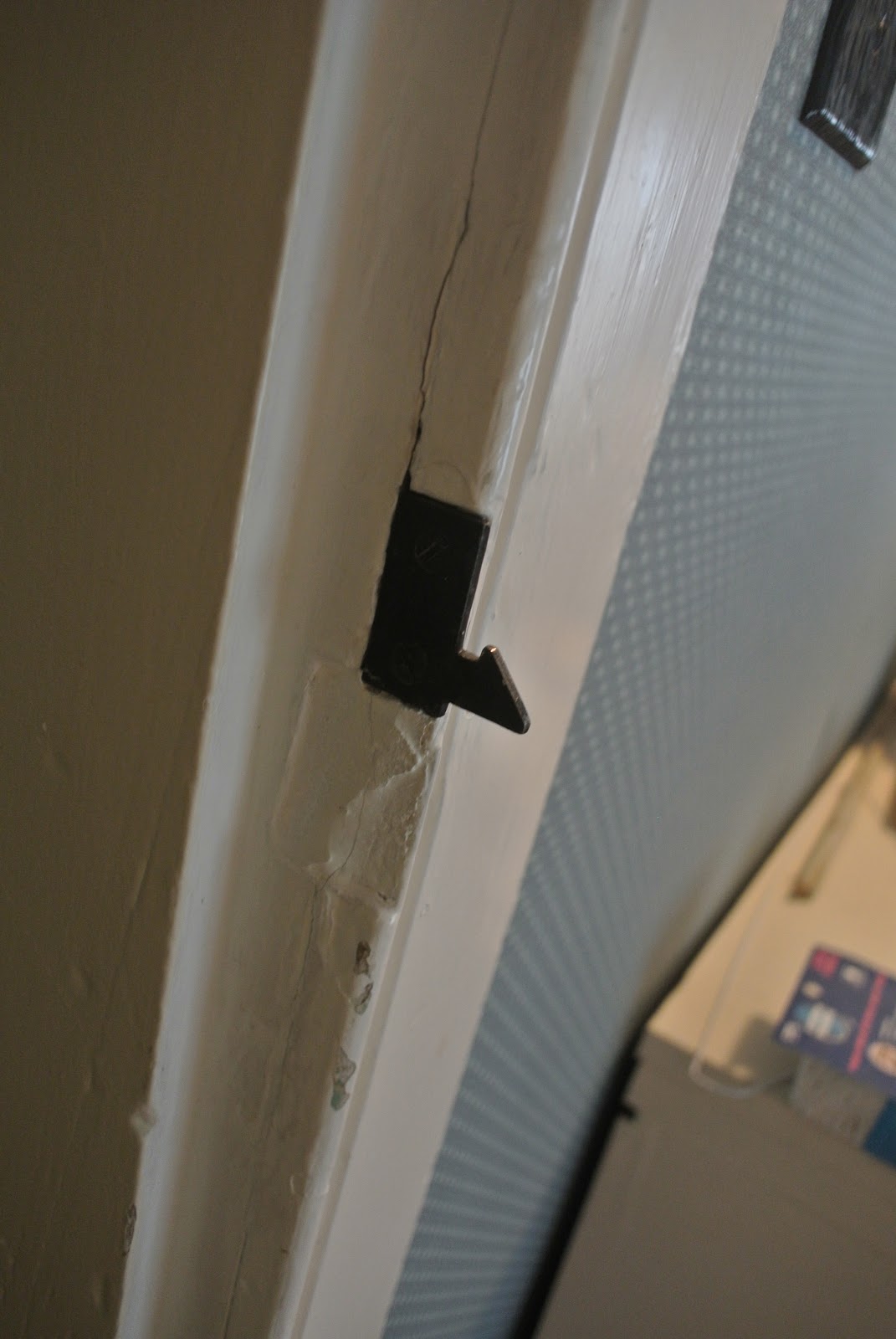
So that's one fix. There is another, which is to tinker with the position of the keeper. That has happened to our bathroom door, and I will do another post on that soon. In any case, here are a series of close-ups showing how the keeper is countersunk into the doorframe. 


You can see, just below it, another place where an earlier keeper was countersunk lower down in the frame. God knows when or why, but that's what I love about old houses. There's such a sense of unwritten, lived history.


And now, again, a series of photos showing the latch bar latching.


And now closed, the inside of the door. Don't mind the odd top hinge ... another fix for an old door.


And there you have it. An old thumb latch for an old door.


Monday, April 15, 2013

1830's Colonial Thumb Latch Hardware: Garage Doors or, slow life

I don't know why, but a lowly and very pedestrian blog post I did about fixing one of my doors, with photos of the thumb latch hardware, has gotten more hits than just about anything else I've written. Well, I'm guessing the reason it does is because there is very little on the web about this type of antique hardware, and particularly, no photos of it "in situ," so to speak. That post is here.

In follow-up, I am going to photograph some more of the thumb latches around the house, even though I don't think they're particularly out of the ordinary. Or perhaps I have just come to accept their existence in my everyday life quickly. Certainly, such hardware was never a part of any other house I lived in.

This post is on the garage thumb latch hardware. Ignore the fact that the door desperately needs a paint job, please. It's on the list ...

I will preface this by saying, I've got no idea when this hardware was installed. Probably when whatever the garage was before was turned into a garage. So, then, after there were such things as automobiles, perhaps? Say, 1920's. That would be my guess. Or later, very possibly. In any case, without more ado:

One of the things that prompted this post was a comment on my earlier post from someone who was installing a thumb latch on an outdoor shed and commented that it isn't lockable.

This hardware, though, is designed to take a padlock. This is a photo of the front of the right-hand door, and that ring that you see is one of the two rings the padlock goes through.


And, in close-up:


Here it is, same door, from a side angle. You can see that the handle on the inside is just a typical thumb latch, though larger than normal. And the mechanism on the outside is much, much larger than anything inside the house.


Here is a photo of the inside of the door, looking out. You can see how the wood was cut away where the latch bar is (or, actually, it is two separate pieces of wood, that overlap the two doors), which leaves a space for the latch to latch.


And, here is the inside of the other, left-hand door:


That slot to the left of the handle is where the other padlock ring/keeper is installed, again, from the inside:


And now, the keeper, from the outside:


From this angle, you can see how the keeper is slotted into the door:


And shimmed:


Perhaps not elegant, but practical and clearly standing up to the test of time.

And now a close-up of the two doors closed and latched with the padlock installed. There's nothing inside of any value, but as the latch itself doesn't always keep the door secure, the padlock also helps to keep the doors closed.


It's terribly inconvenient to open and close garage doors this way, but it goes to what I've been writing about slow gardening. Slowing down to unlock and pull each door open--and then, again, the reverse--forces me to pause, enjoy the air or the sky or wind or rain or sun or whatever, and to move at a different pace. And I like that. Slow life.


Thursday, February 21, 2013

Minor Interior Door Repair: 1830's thumb latch hardware

This weekend, I had a very minor repair to make to the latch between the dining room and hall on the first floor. The problem was simple, the screws were falling out of the door. This has happened to three doors since we moved in--we're just too hard on the old things, I guess.

The first time it happened to a spare bedroom door, I had no idea what to do, and locked the door latch up in my desk drawer so noone would try to "fix" it wrong. Several months later I stumbled across a note in an issue of Old House Journal, with the advice to shove the wooden ends of matches covered with carpenter's glue into a stripped out screw hole, let it dry for 24 hours and then re-screw the screw into the now newly filled hole. Bingo! It works.

Here it is demonstrated--

Problem -- door latches, but without a working handle on the other side, can only be unlatched from this side:


Hardware removed, with two match sticks glued into the stripped hole:


Match sticks sawed off:


And, just for fun, a close-up of the door without its handle. Easy to spot, in the ridging of the paint, the fact that there was, at one time, a slightly shorter but similarly shaped handle on this door, and, before or after that, a bolt on the other side (screw holes above the latch).


In any case, it was the work of a few minutes to re-install the handle:


And, the view on the reverse of the door, also showing another spot where some kind of hardware was once installed.


The view from the side,  showing both sets of hardware back in place:


And, for good measure, a couple views of the installation of the piece on the frame that receives the latch that looks like a hook, which is called a keeper (ignore the other handle on the door behind):


And, finally, a view of the entire latch mechanism, closed and secured:


The whole process makes me curious about the history of these door latches, though. I've never lived in a house with NO interior door knobs. Not one in the entire place. Every door has a version of this cast iron latch, and they're all virtually the same in look and feel. That fact, in and of itself, makes me feel pretty certain that they're replacements.

But replacements for what? The photos above make it clear there never was a traditional door knob assembly on this door. Every other door in the house is the same. So, this house was built with this kind of latch.

What are they? A bit of digging around on the web revealed that they are colonial thumb latches, most often imported from England during the 1700's, but at some point, made also in the U.S.A. Used from the colonial period up through the 1830's, and then sporadically to the late nineteenth century.

Easy to find today, as reproductions. I've found them here on the website for House of Antique Hardware, called rim latches on their site. And, as antiques, on Ed Donaldson's Hardware Restorations, where he displays images of antique thumb latches.

Most of the doors in the house seem to be original to the house, or to the era it was built in. Who knows where these two hall doors were first used. I don't think there was a doorway between what is now the dining room and the hall, originally. There certainly wasn't a door to what is now the half bath (which you can see behind the hall door, in the photo below) when the house was first built. But I do think they are original to the house, because the wood is ancient and the four-panel solid wood construction, but very thin, is an old construction and the layers of paint and age of the wood are consistent with other original elements, like the windows. And, because all of the doors show signs of having been shuffled around, like an old, slow, giant game of musical chairs. Musical doors.

Which is a long way of saying that these are old doors, and now fixed! Cool, says Minky, from her perch.