Wednesday, March 20, 2013

March Weeds: Nature's first green is gold ...

It's Sunday morning. The cats are a). sleeping ...


b). patiently waiting for me to come play ...


But the north border is calling, furzy headed thing that it is ...


So I suit up in my long johns (yes, long johns to garden), wool socks, jeans, turtle neck, down jacket and latex gardening gloves.

But before I attack the border, I trudge up to the forsythia and grab three of the highest branches, the three I'm likely to want to prune anyway, come summer. I pull them low to snip "less than 3 feet," the instructions say. I go open up the basement and plunge them into a bucket of warm water.

Then I trudge back to the border and wade in. Roots. Roots. Canes. Canes. Vines. Vines. Roots. Oh, yeah. Poison Ivy.

I quietly thank the daughter of the former owner, who has written me on various matters related to the house, and who, in passing wrote that there was poison ivy in the border and that she'd tried to spray it a bit with Round-up. I've never seen it, but then I've never really peered into the underbelly of this beast. So a shout out to C.C.  I would've never known to be on the lookout. It's there alright. Not too much, thankfully. I'm glad you sprayed!

Three hours later. Presto chango. Another bit done. Maybe a third, with two days work, if I'm lucky. If you look close, you can actually see the mystery bush revealed at the far end.


I leave the brush clean-up for a warmer, brighter day. Besides, I like seeing it pile up.


Later, in the Sunday afternoon quiet, I bring up the forsythia. I've never tried this, but they say it is easy to force the blooms. And I, apparently, have a bad case of spring fever.

So does Phantom ...


Moments later, the whole thing goes over, of course. But I'll spare you that bit.

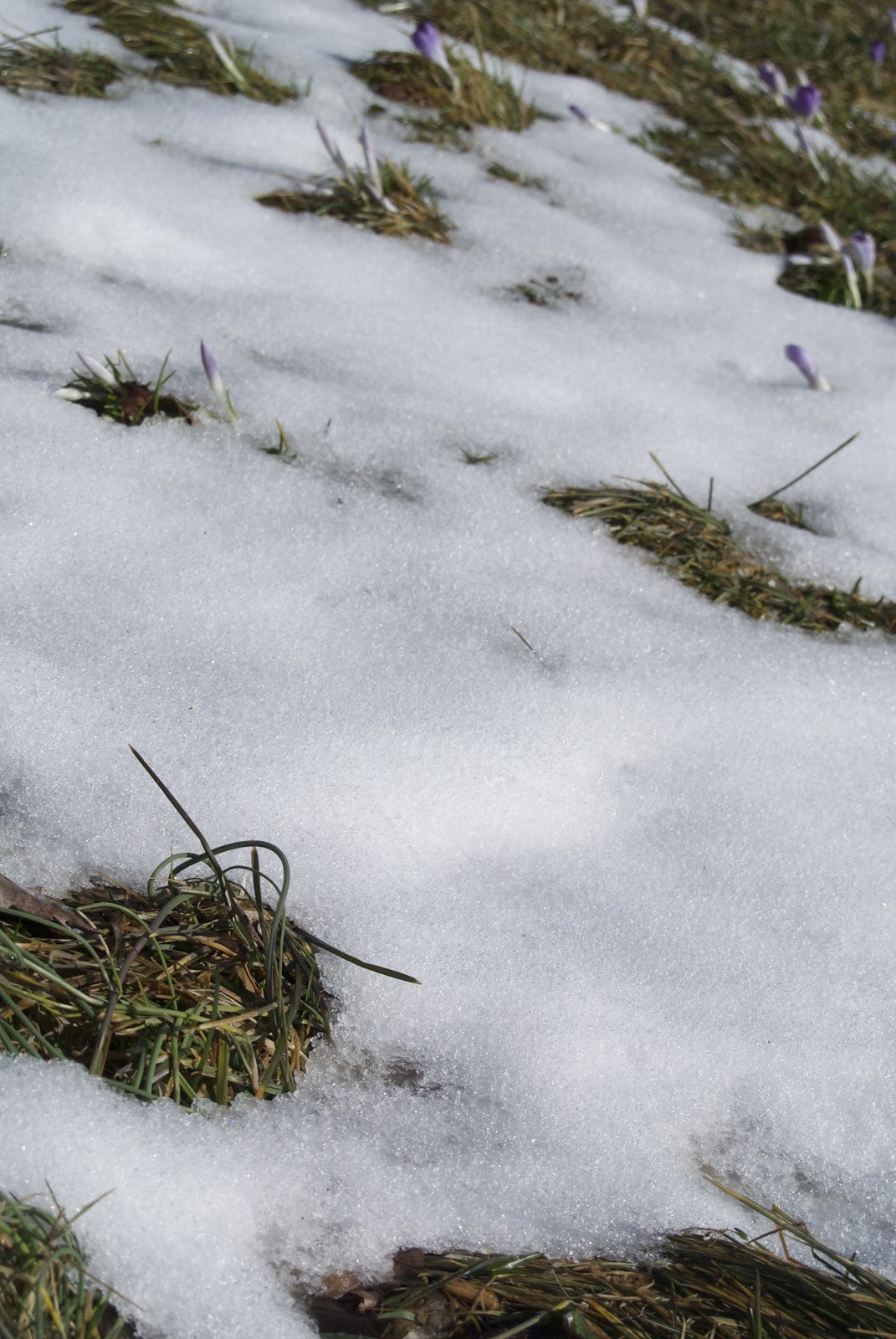
So, I didn't get any green on for St. Paddy's day, but I got some gold.

Robert Frost said it first ...

Nature's first green is gold
Her hardest hue to hold
Her early leaf's a flower
But only so an hour
Then leaf subsides to leaf
So Adam sank to grief
So dawn goes down to day
Nothing gold can stay.


Sunday, March 17, 2013

Weeding the North Border: Organic responses to totally noxious invasive rhizomatic weeds and vines in an established border

Like many yard keepers, I share a "problem" border with a neighbor. You know the one I'm talking about--it's totally overgrown with some unknown invasive plant or plants and straddles the property line, making it a shared no-man's land.

Mine is on the north border of our property. It used to be someone's showpiece, I am certain, because it has some amazingly beautiful old flowering bushes, ground covers, and a few lonely crocus, hosta and other flowering bulbs, which have, of course, been completely overtaken with multiple invasive plants: a rhizomatic weed that keeps springing up no matter how much root you think you've gotten, at least two and probably three species of vine, including oriental bittersweet and things that look like grape vines but aren't. Oh, and possibly poison ivy. Yay.


I've conveniently ignored it for two summers, and finally last August, when the vines starting shooting out of the tops of every bush, smothering the mountain laurel and growing up into my dogwood, I realized that if I don't deal with it soon it will get so out of control it will be impossible. 


But, my problem is that I can't just dig up the entire border if I want to keep the old, established bushes.  Rooting out roots indiscriminately isn't an option--not to speak of the dangers if there is poison ivy root. And I don't just want to put down landscape fabric and mulch, because I want to plant more bushes there--a lilac, a witch hazel, hydrangeas--, and, ultimately I want to add perennials: peonies, maybe daisies, russian sage, cone flower. 


I can completely see a beautiful perennial flower border here. So, I need a living, breathing soil. Preferably clear of rhizomes, vine root systems and poison ivy.

Yesterday, after a fair amount of reading and research, I finally started to tackle it. Yes, in the SNOW!


And no, I'm not crazy. I have a plan. 


My plan is to play a long-game war for as long as it takes to smother, slash and uproot the weeds without affecting the existing flowering bushes, i.e., organic war. I'll wait as long as it takes. When they're gone, I'll plant.


So, first things first, here are the beautiful old flowering bushes in the border, from front to back.


The first two are a hardy blue-eyed daisy shrub side-by-side with an andromeda (pieris japonica). I can't find any mention  online of a hardy blue-eyed daisy, but in fact, I seem to have one. Here is what it looks like now (the privet hedge in the background is the neighbor's front yard):


Here's the Andromeda, now:


And here they are last August, completely overrun with multiple vines into one gargantuan monster bush. Ouch.


Behind the andromeda is a large, pink azalea on the neighbor's property, which the neighbor keeps well-weeded, shown here as it looked yesterday: 


And here, last August:


And then, underneath the dogwood is a very small white azalea, which you can see to the left and behind the dogwood here, in August:


Then from left to right (standing in my property), there is a medium-sized white rhododendron, a real mountain laurel, and another andromeda. Here are two photos, showing their relationship to the dogwood and to each other, taken from one of my second-story windows, yesterday:


And here is where the trouble starts. First, the land drops off in a gentle hillside and starts to be in full sun. The top of the hill is my property. The bottom is the neighbor's. But I don't know where the property line is. As I haven't weeded on my side of the property for two summers, by last August it was a nightmare:


At the far end, impossible to pick out in the tangle of weeds, is a beautiful old bush that has white flowers in June. No idea of its name.

These feathery weeds are taller than me. And, as I have been battling smaller versions of them on the patio for two years, I know that they propagate by rhizomatic roots that will resprout from the tiniest fragment left in the ground. Here are they are now, in dead of winter:


And here, in close-up:


 Those rhizomes are already sprouting new leaves, here, more visible on the patio:


My plan is to cut down all the canes to the ground and cover everything with black landscaping fabric, the polypropelene kind. I'll leave it down for the summer, then take it up and chop down anything, put it down again, and do the same thing again next spring, and the next, until the roots are dead.

I am imagining, though, that the rhizomes and vine root system will try to migrate and sprout out beyond the fabric, in the yard. So, when that happens, I will probably have to dig out whatever is coming up beyond the fabric. I haven't talked to the neighbor yet, but I will, because unfortunately,  I think, being no respecter of boundaries, the weeds will try to grow out on her side too, of course.

In fact, I've found a website from a guy who recommends this very thing for Japanese Knotweed (though my problem plant doesn't seem to be knotweed). Still, here's good description and link here.


For instance, you may wish to keep a tarp over the bulk of the problem area during the warm weather months, slashing/poisoning along the perimeter as necessary. Then, in late autumn/early spring, dig up as many of the rhizomes as you can (again, if only to ensure even ground for your tarps, lest they be punctured). Afterwards, place the tarps back on -- even though winter is on the way. You want the tarps to be already in place for the next growing season. That way, in case you get busy with your gardening in the spring and find yourself pressed for time, you don't have to worry about remembering the tarps.


So, yesterday, in the snow, I started. And I got quite a respectable pile of brush, in the few hours I worked.


And a pretty coating of onion snow, to boot.


Friday, March 15, 2013

For Debbie: Antique doll dishes

This post is for my sister Debbie, who asked me to post photos of these doll dishes we found up in the attic of our childhood home, which was the parsonage of our father's church. I don't know if she remembers, or if she was there when we found them, but we (some of my three sisters and I) found them in a sweet little wooden cupboard, probably an old medicine cabinet, stored away under the eaves in the part of the attic that was sealed off as dead/storage space.

A bit of online research this weekend revealed that they're probably Akro marble glass. Akro was a company that originally founded in Akron, Ohio around 1910 or so to make marbles. Akron is about an hour from where I grew up, and my parents, grandparents, aunts, uncles and cousins were all from that area. The company eventually moved south and added toy dishes to its product line, before going out of business in 1951. These dishes don't have the Akro trademark, but they have the hallmark design and coloration.

These always seemed mysterious and fanciful found objects, the lost treasured possessions of some unknown girl who lived in our house before we did, and so a bit magical.


Wednesday, March 13, 2013

Eating Local - Reclaim, Reuse, Recyle Depression Style

When I was growing up in 1970's era rust-belt Ohio, my father was a minister, or pastor, he would say, in a small town outside of Youngstown, Ohio. It was a predominantly Catholic area, and so the Baptist church was small, the members blue-collar steel and auto workers.

The older members of the church had grown up in the depression and lived through the World War II victory garden era. They all had backyard vegetable gardens, and grew tomatoes as big as houses, cucumbers the size of small engines, zucchinis a mile long, and green beans as tough as rubber with strings to rival violin gut that simmered down to soft sweetness when boiled forever with bits of bacon in the broth. In late summer, these things would flood into our house by way of church services, arriving at the church in bins and boxes, bushels and paper grocery sacks full, turning our house into a miniature food factory.

But one of the deacons of the church went one further, inviting the whole passel of us over for visits to see his garden and share in the bounty. He and his wife would host us in the long summer evenings, shadows slipping into gloom, elongated over the green grass until they seemed to stretch into infinity. One of my fondest memories--well, frankly, one of my many memories of a world that seems to have disappeared--is of those summer evenings at the McLains'.

They had a neat, tidy red cape that my father told me he'd built himself from scraps and whatever he could find to build with. Even when we knew him, in his 70's, he'd walk the roads picking up whatever odds and ends he found along the way. And in the basement, swept so clean you could have eaten off the concrete floor, bins and bins were ranked in careful rows, where he sorted his finds. Brass, steel, iron, screws, nuts, bolts, hub caps, pipes, what not. He'd use what he could and take the rest to the scrap yard to sell.

They had a garage, a big, midwestern kind of thing, two- or three-car-wide sized, or so it seemed to me then, and on our summer visits he'd walk us down the garden. Here were his beans, here his tomatoes, Big Boys, Early something or other, and here his rows of corn. And my father would quiz him on how he pollinated his corn. They'd talk and we would run, just run flat out, in the short mown grass, cool with June evening.

Then we'd eat on a long picnic table set up in the garage, or outside on the drive, depending, and after decamp to the screened in summer porch beside the garage or the porch swing out back of it. And the grown-ups would talk in long melodic ambling conversations, while me and my five sisters and brothers would run and jump and climb the giant maple tree above the swing.

That, it seems to me, is local eating, integrally bound up in a "use it up, wear it out, make it do or do without" style.

So I had to laugh last night, in Manhattan, when I saw a sign in a coffee shop--milk sourced exclusively from antibiotic-free local farms. Last time I checked, there wasn't a farm within spitting distance of Manhattan. And believe me, while I like my fair trade espressos and cappuccinos, my hand-crafted Brooklyn chocolates and my locally made artisan cheeses, the new "local" ain't got nothing on eating local 1970's midwestern depression-era style.


Monday, March 11, 2013

Pruning the Dogwood: Local Heritage Garden 6

Before we bought this house, we lived in Sleepy Hollow for a year (yes, the Sleepy Hollow of the headless horseman). Our rental house had a dogwood. We moved in in July and I spent a whole year wondering what color that dogwood was, and when it bloomed it was an amazing deep salmon color. Just breathtaking.

But white has always been my favorite dogwood color, and so when we had put an offer on Pugsley, I made Capel drive by one day after the dogwoods had come into bloom, just to see what color "our" dogwood would be. Here it is, in its spring glory, last year.


Here it is, in summer. If you look closely in the photos above and below, you can see a hole in the upper left (front) of the tree foliage. There's a branch that split, some time ago, and has been hanging. That branch really bugged me. 

The beautiful old dogwood at our last rental home had numerous dead branches and split branches up in its top, and much of the year it looked like it was on its last legs. So I swore to myself that if I ever had a dogwood, I'd keep it pruned and loved.


So, fast forward 9 months. I'd done my homework (late, as usual) sometime in the frozen deep of this winter, and learned that the best time to prune a dogwood is in fall or winter, before the sap rises. Well, missed the fall, and the winter was so bitterly cold there was just no way. Hate to say it not even dogwood love would pull me out into pruning mode. But, the minute it warmed up a tiny bit, this weekend, I said to Capel, "Honey ... "

Here's the split branch.


I kinda assumed I could get to it with a ladder. Laugh. So, after donning appropriate footwear, up I went, with more than a little trepidation. I cannot remember the last time I climbed a tree, other than since I was like, maybe 14. But here I am, about fifteen feet up off the ground, trying to figure out how to get the right angle on the branch to saw.

By the by, I use a Fanno 13" curved pruning saw I got from Amazon for $20. It's incredibly light and sharp, and even if you're slow, like me, it will eventually cut through anything.


All of the advice on pruning out whole branches is to make two or three cuts. The first two, a foot or so out from where the branch attaches to the tree. That's to keep its weight from splitting down into the good wood of the tree before you get it sawn through, and thus killing the tree instead of saving it. So here I am, hugging tight for dear life and leaning out, sawing into the split at least a good foot from the fork of the branch I'm taking out.


And, relieved, first cut has worked. Now to take off the remaining stump.


And here we go, all done, the branch cut neatly back to the "collar" -- that spot where the branch attaches to the tree. A good day's work.


Thank you to Capel for taking the photos and being ready to catch me should I fall out of the tree!

Oh, and by the way. Beach shoes make GREAT climbing gear for trees. Highly recommended and styling too, as you can clearly see.