Showing posts with label Poems. Show all posts

Sunday, April 21, 2013

Guest Blog: Monarch Migration Plunges, Plant Milkweed

Guest Blog
by Jonathan Skinner


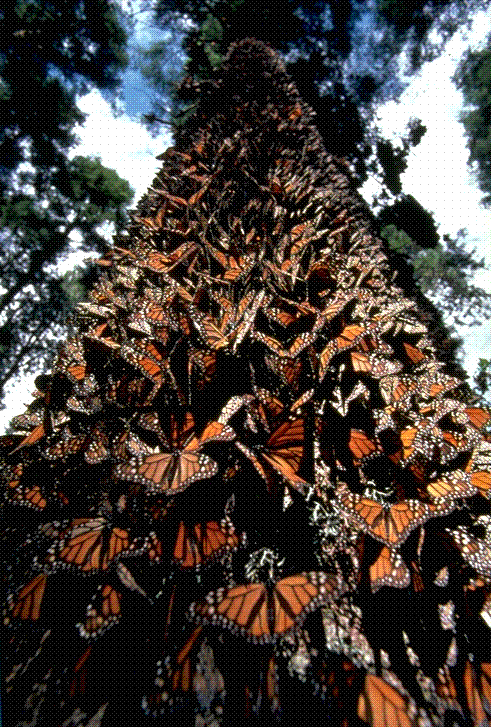
I was fortunate to visit the monarch sanctuary in Zitácuaro (Estado de Michoacán, Mexico) many years back. Little could have prepared me for the erotic charge of thousands upon thousands of copulating monarch butterflies, hanging from the pines and falling through the air.

North of the border, little prepares one for the diaphanous and buoyant appearance of these hardy voyagers.

Are we prepared for a time when the glory of the monarchs' migration will live only in our childrens' storybooks? 

Excerpts from a recent New York Times article read:
The area of forest occupied by the butterflies, once as high at 50 acres, dwindled to 2.94 acres in the annual census conducted in December, Mexico’s National Commission of Natural Protected Areas disclosed at a news conference in Zitácuaro, Mexico. 
That was a 59 percent decline from the 7.14 acres of butterflies measured in December 2011.
But an equally alarming source of the decline . . . is the explosive increase in American farmland planted in soybean and corn genetically modified to tolerate herbicides. 
The American Midwest’s corn belt is a critical feeding ground for monarchs, which once found a ready source of milkweed growing between the rows of millions of acres of soybean and corn. But the ubiquitous use of herbicide-tolerant crops has enabled farmers to wipe out the milkweed, and with it much of the butterflies’ food supply. 
 A rapid expansion of farmland — more than 25 million new acres in the United States since 2007 — has eaten away grasslands and conservation reserves that supplied the monarchs with milkweed.


A more in-depth report can be found here.

When I wrote "Unfolder," I was thinking about forest fires. Fire, I now realize, takes many forms. (Including, perhaps, the fire of my own intrusion on that place.) Here is my poem for the day (originally published in Political Cactus Poems, Palm Press, 2005). 

BOYCOTT MONSANTO COMPANIES. PLANT MILKWEED. 


Unfolder

the ardent ending
monarch’s ardor began
a large wedge-shaped
cloud in the spring
thousands were taking
a fluent thoughtful nap
re nocturne, alone
all of them witch-doctors
or in a Chinese dream
woken-up philosophers
the single golden rule
overarches, ark or pendant
limpidity of clouds

overlord my monarch
the length of two thumbs
light fills the windows
clings to sun struts
grows outward, leafing
monarch emerges steeled
blood jams into wings
all that tickling insect
clasped to cock’s fuzz
is a trance, inside syrups
a poison swapped about
bitter-tasting heart’s
spasm, an orange avoid

a million pages turning
the library of spring
spotted with shadows
the piteous monarch
propagates, replenishes
ejaculates homeward
to completion in summer
the monarch’s a cloud
woven of monarchs, one
leaf journey’s length
pulsating on, from ghosts
and milkweed deposits
a universe of monarchs

lazy winter monarch
on a warm day ventures
out for nectar, rubber
in the saps & rough stems
loves the poisoned milky
fields, sleepy his “eyes”
open above the coccyx
looking for black-smudged
veiny queens, wooed
by the harmfully harmless
lauzengiers, wing deep
slips between sign & referent
are not what they seem

monarch’s no mimic
no midas, this goldfeeler
melts you to the ore
nympho or mendicant
exasperating progress
discovered by millions
with wing covered sexes
gets sticky all over
in Zitacuaro it’s quiet
piteous monarch, go
roving, unfolding, trees
branched into flames
would that you lasted


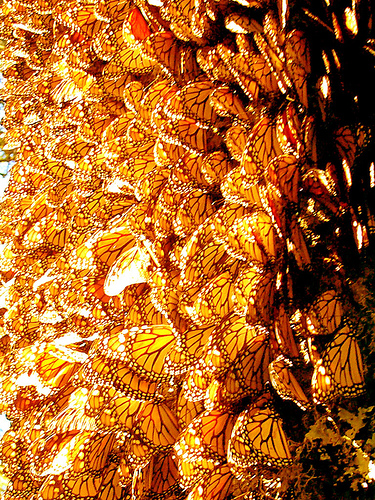
NOTE: Written on news of a forest fire at the monarch butterfly (Danaus plexippus) sanctuary in Mexico. “Lauzengiers” is from Old Occitan and means “flatterer.” The flattery of the edible viceroy mimic (Limenitis archippus) threatens the monarchs’ warning system—bright coloration meant to warn predators of the distasteful cardenolides the monarchs sequester from milkweed. When roosting monarchs unfold their wings to gather sunlight, it is as though an entire tree bursts into flame. 


for more on Jonathan Skinner and ecopoetics, see a fine interview at Poetry Foundation here.

*

Thursday, April 11, 2013

Forsythia Frost, Spring

Yesterday, the Forsythia bloomed.


It put me in mind, again, of the poem by Robert Frost, which I keep meaning to write about. I'll quote it again:

Nature's first green is gold
Her hardest hue to hold
Her early leaf's a flower
But only so an hour
Then leaf subsides to leaf
So Adam sank to grief
So dawn goes down to day
Nothing gold can stay.

Every spring, like clockwork, this poem comes to me. I must have memorized it, along with others, in grade school. But I don't remember it being particularly memorable to me then. It only came back to me later, when I was a young adult and living on my own in my second apartment, a third-story nest in the top of an old house, and started to truly look at the world around me.

I noticed then, that very, very early in the spring, really late winter, before anything buds or blooms or sprouts or pushes up, the very thin furthest twig ends of certain trees start to redden. I was perched up there on the third story, and I'd look out at the horizon, a band of trees in the near distance, and the line against the sky was faintly pink, like a reverse sunset, and day by day became redder and redder until, one day, leaves appeared, the tiniest reddish bursts of color.

The second year this happened, I felt a strange kind of anticipation. This is spring coming, I'd think. It's got its own fore-runners! And I started to look around and see others. I think it was then that Frost's poem returned.

The town I grew up in, McDonald, Ohio, is a very small steel town. When we were young and growing up, its streets were lined with maple trees. Not young ones but not old ones. These were young adult trees, with robust, deep green leaves and round ball-shaped crowns, neatly marching up and down every street of the grid that mostly defines McDonald.

And I noticed a curious thing. The seeds of the maple flower before the leaves. They sprout like tiny wings, fluttering out day by day. But they're not wings, or leaves, or seeds. They're tiny little flowers. And they're not quite green. Not quite gold. They're spring.

This, I thought then, is what Robert Frost means. The seeds before the leaves. And for many years, this is what Frost's poem has meant to me.

But this year, as I pondered this poem that for me has become a seasonal pondering, I thought about the lowly forsythia. Most of the year a totally unspectacular shrub. Sometimes a wild haired scrawny child. Sometimes a tangled weed of a thing. But in the spring, before anything blooms, except perhaps the crocus, before its own leaves even, it floods the world with gold.

And that you can count on. It keeps coming back. It's pretty tough, that forsythia.

And yes, it fades, but other things come to take its place. And I just can't see that as a sad thing. And for me the Frost poem, too, is not a sad thing. It's a kind of renewal, in the spring of every year. A tradition. A chant. The harbinger.

So I say to Robert Frost, no, nothing gold can stay. But it can return. And it does. And that, that returning, that is spring, to me. And poetry.

Tuesday, March 26, 2013

What is Your Favorite Tree?


The Hudson was beautiful this morning when I drove down the hill to the train, the Palisades tinged pink with dawn light and white with snow. But I can't help thinking about that poem of Robert Frost's, which I quoted in a post the other day here. My mind always turns to that poem of Frost's this time of year, or has for a long time.


When I was a little girl (bear with me on this), my favorite tree was the maple. My grandpa Brennan had two massive maple trees in his front yard, and I think we must have had one in ours, too, because one of my favorite things to do in the spring, after the seeds had dried and fallen, was to throw handfuls of them up in the air and watch them spin, lazily down.

And my mother, who must have been hard pressed some days to keep my busy little mind occupied, showed me how to peel the seeds, tearing away the brown fin, and the harder film underneath that held the two halves of the seed together, pale green with its tiny tail of a sprout tucked in. And she gave me glue and paper and showed me how to make designs with the halves of the seeds glued into patterns.

That must have kept me busy for a half hour anyway. We had a grey house in those days, probably built in the early 20th century, with a porch and classic grey porch stairs. Or so I remember it, anyway. And I'd sit on one step and use the next one up as my desk. Pasting away. Then after awhile, mom would bring out a little tray with a tea party on it, and I'd drag out my dolls and serve them all weak tea watered down with tons of milk and sugar, and bits of toast cut into toast points spread with honey. And I'd go around the circle of dolls offering each a sip and a bite, and end the party by eating and drinking it all.

And that was how the maple became my favorite tree. Although the pine was a close second. That was because of Heidi.

I don't think I've ever seen the movie, but in the book, one of the things Heidi loves the most is the roaring of the wind in the pines behind her grandpa's hut. And in our side yard, that same yard with the porch stairs, was a short line of young pines. I would creep in under the pines, where the branches hung low, and study them. Ours didn't roar. But they had a strange white pitch that seeped out from places where branches had been sawn away that, when touched, would make my fingers stick together in a curiously uncomfortable fashion.

Later on, in my 20's in Chicago and then my 30's, in Pennsylvania, the pine became my favorite tree. The early skyscrapers, which Chicago was so famous for, being the city of big shoulders and all, were said to be modeled on the pine, with its long, deep taproot. The pine can flex with the wind, and bend and not snap, because of this taproot. And I liked thinking of the herd of tall Chicago buildings as a stand of pines, and even later, of life as a pine--the deeper one's taproot, the more one can flex and not break in the bitter winds. And when I moved to the Pennsylvania hills and learned to hike in them, I would think of all this, as I hiked among the forests of hemlock.

But now, in my late 40's (I'll be 50 in June, yikes!), the oak has become my favorite tree. The oak is very slow to grow. It takes an entire one of our lifetimes for an oak to grow into its true maturity, and then, with luck, it is just getting started. And I like the idea of a tree that persists like that. There is a stand of oaks across the street from Pugsley, in what is known as the Campwoods Methodist Summer Camp. These oaks are neither young nor old. They're sturdy and strong and striking. I'll snap a shot or two for you.

One of their babies, I think, has rooted under my yews, by the front porch, in its own little protective nursery. And when it gets just a little bigger, I want to transplant it into the front yard and give it space and time to grow.

Another day, I'll write about the trees that have inhabited the Pugsley yard. For now, suffice it to say that it feels to me that the yard and house wants an oak this time. Hopefully if we're lucky that oak will be here with the house long after all of us are gone.

So then, I've managed to talk about everything but Frost this morning. I'll save that for another day. We've got a wait for spring, it seems. And so there will be time enough for that.

In the meanwhile, I'd be curious to know what other people's favorite trees are, and why.


Sent from my iPhone

Sunday, March 24, 2013

Forced forsythia: Rachel Blau DuPlessis

Today the forsythia inside have bloomed.


There's something compelling about forsythia, one of the earliest spring blooms. And only just this year, I learned that the branches can be brought in and forced, and so I tried it, and today I have flowers (and cats who cannot resist them, alas, so they--the flowers, that is--which have gone over twice already, have to be penned up in a room with a door). A good description of how to force forsythia can be found here, on About. com. Mine took about a week to bloom.

Here they are, still frosty, outdoors this morning:


A week ago, when I brought them in:


Yesterday morning:


And today:


It puts me in mind of a poem I once puzzled over by a poet whose work I came to love many, many years ago, when I was a young poet, Rachel Blau DuPlessis. This is a selection from the opening of a much longer poem, from her book Tabula Rosa (1987).


Crowbar

Snow on o-
pen
yellow for-
sythia.

'Sno
won
open force
scythe
ya.

No one
yell ow--you
yellow mortal thing
ringed in
dull earth's icy garland.

...

Even the lever is a gleaning.
"Thou" art the fulcrum.


She's writing about flowers and women. It's not all pretty, perhaps, but then it never has been. Today, I wonder if Rachel knew that forsythia can be forced. It's interesting, the uses that a flower can make, of words. I've thought about that syllable "force" buried in forsythia, ever since I read this poem. They're a powerful flower. And still, they blow me away, both, the words yes, and the flowers, too, every spring.