Monday, April 15, 2013

1830's Colonial Thumb Latch Hardware: Garage Doors or, slow life

I don't know why, but a lowly and very pedestrian blog post I did about fixing one of my doors, with photos of the thumb latch hardware, has gotten more hits than just about anything else I've written. Well, I'm guessing the reason it does is because there is very little on the web about this type of antique hardware, and particularly, no photos of it "in situ," so to speak. That post is here.

In follow-up, I am going to photograph some more of the thumb latches around the house, even though I don't think they're particularly out of the ordinary. Or perhaps I have just come to accept their existence in my everyday life quickly. Certainly, such hardware was never a part of any other house I lived in.

This post is on the garage thumb latch hardware. Ignore the fact that the door desperately needs a paint job, please. It's on the list ...

I will preface this by saying, I've got no idea when this hardware was installed. Probably when whatever the garage was before was turned into a garage. So, then, after there were such things as automobiles, perhaps? Say, 1920's. That would be my guess. Or later, very possibly. In any case, without more ado:

One of the things that prompted this post was a comment on my earlier post from someone who was installing a thumb latch on an outdoor shed and commented that it isn't lockable.

This hardware, though, is designed to take a padlock. This is a photo of the front of the right-hand door, and that ring that you see is one of the two rings the padlock goes through.


And, in close-up:


Here it is, same door, from a side angle. You can see that the handle on the inside is just a typical thumb latch, though larger than normal. And the mechanism on the outside is much, much larger than anything inside the house.


Here is a photo of the inside of the door, looking out. You can see how the wood was cut away where the latch bar is (or, actually, it is two separate pieces of wood, that overlap the two doors), which leaves a space for the latch to latch.


And, here is the inside of the other, left-hand door:


That slot to the left of the handle is where the other padlock ring/keeper is installed, again, from the inside:


And now, the keeper, from the outside:


From this angle, you can see how the keeper is slotted into the door:


And shimmed:


Perhaps not elegant, but practical and clearly standing up to the test of time.

And now a close-up of the two doors closed and latched with the padlock installed. There's nothing inside of any value, but as the latch itself doesn't always keep the door secure, the padlock also helps to keep the doors closed.


It's terribly inconvenient to open and close garage doors this way, but it goes to what I've been writing about slow gardening. Slowing down to unlock and pull each door open--and then, again, the reverse--forces me to pause, enjoy the air or the sky or wind or rain or sun or whatever, and to move at a different pace. And I like that. Slow life.


Sunday, April 14, 2013

Today in the Garden: Lady Ferns, Daylilies, and more work with hoe and shovel


Today there are lady ferns to plant ...


And a long, slow work of making a garden from scratch ...


But first, with the first cup of coffee, a walk around the yard to see what is growing.

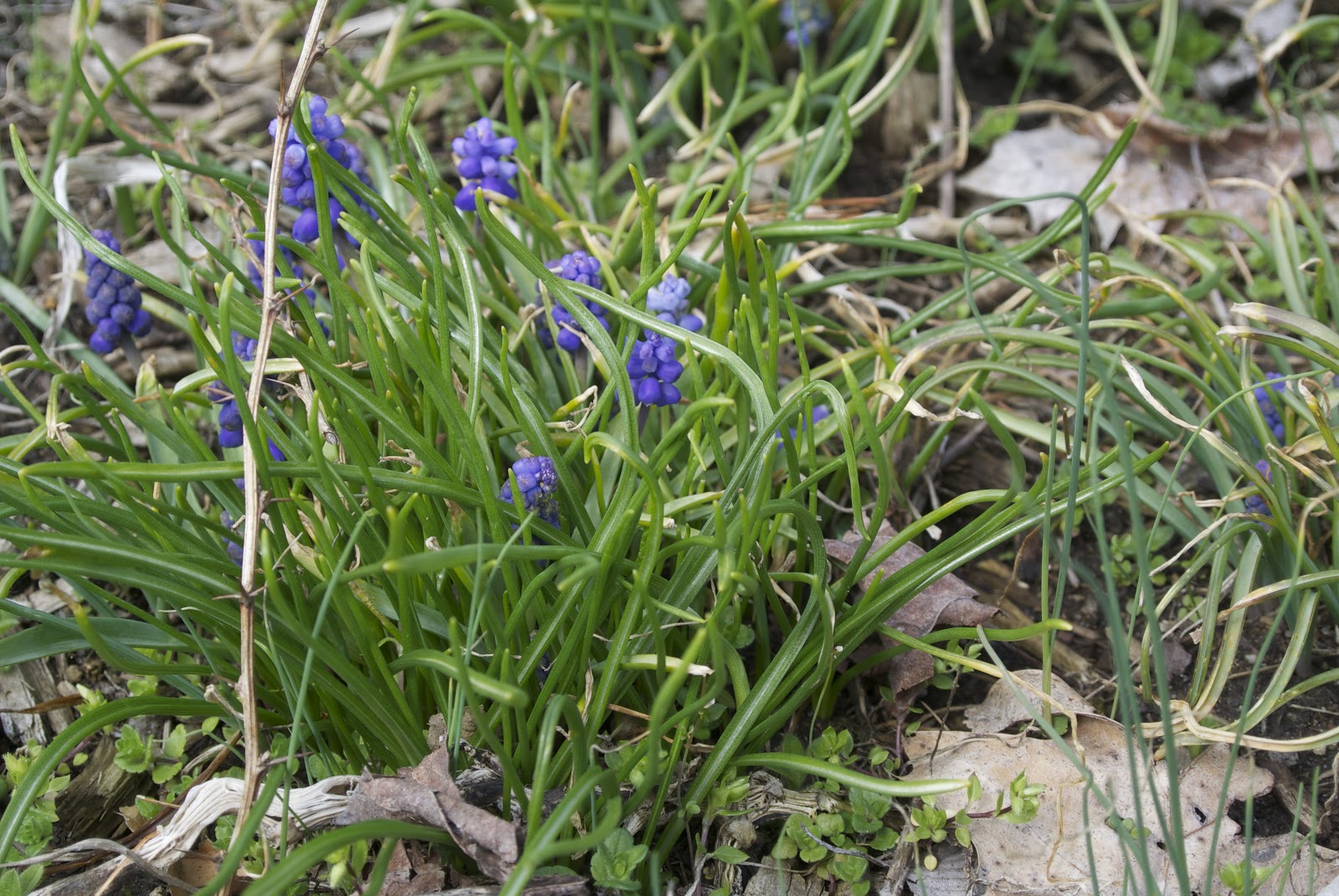
Foxglove, tulip, narcissis and grape hyacinth greening ...


Some pretty weed whose name I don't know starting to bloom in the yard ...


And this one, pretty now, despite sometimes being too invasive ... is this ajuga? Or some other weed? I'm not sure, but I've made my peace with it.


 The well garden happy ...


The daffodils smiling in the backyard ...


Hyacinths, daffodils and johnny jump-ups make a pretty combo ...


grape hyacinths coming on


and chives, behind them.


And then, to work. The 15 daylilies are coming out of this garden, which gets too much shade ...


and instead, lady ferns, ...


heaven's gate coreopsis and blue waterfall capanula go in ... so that's done.


The new garden is my plan to kill two birds with one stone, so to speak. It will help me discourage people from driving on the side of the lawn, and it turns the most sunny, most visible corner of the yard into a full sun flower garden ...


Much trudging up and down the street with pails of daylilies in the wheel barrow ...


Old cedar siding turned into plant labels!


And so much work the poor body has no energy left for long blog posts ... but a good day's work nonetheless!


Friday, April 12, 2013

Slow Gardening - New garden from sod: to rototill or not to rototill? That is the question.

It's raining. I look out the kitchen window and see raindrops,


forsythia, and daffodils. Spring!


And inside, boxes of new plantlets, just arrived and waiting ...


I wish I could post smell. The smell of dirt and earth and compost and living things is intense inside this box, just dip down your head and smell. Yum.


That box has lily bulbs and campanula plugs. This one, below, has more lily bulbs and bareroot ferns.


And I have a plan. To move the daylilies from this bed, behind the forsythia, which I dug up last year and proved to be too shady. So I take the daylilies out, put in some part shade plants like fern and  capanula and heaven'ts gate coreopsis ...


and put the daylilies in this garden, which gets sun all day long, but is not really, not quite, not yet a garden. Actually, it's YARD. Yard, with a husband who, last Sunday, in this shot, had just spent two hours with the shovel and rototiller conquering the sod. For which I am incredibly grateful, because I could absolutely not have dug that whole garden in a day without him and his tools.


But my tool of choice? The lowly hand cultivator rake. Don't laugh. Honestly. I'm sincere. (By the way, my mother gave me this hand rake many, many years ago and I carted it around through life in more apartments with no garden than I'd like to admit, till now. It has a green pad around the handle, which I used not to like, because it catches the dirt. But it also saves the hand from blisters. Thanks mom!)


Here's a close up of the garden. That part in the foreground, all nice, broken up dirt -- I did that with the hand rake (after there was a good hour of work with spade and rototiller, true, but still, an hour with rototiller and two hours with hand rake, that's the key). The part beyond, all clumpy sod, that's the part that has so far only been dug with a spade and rototiller. That does not a garden make.


Here you go, another shot of American Gothic proportions. On the right, the work with hand rake. On the left, the work with rototiller.


Now I'm sure they make a much bigger machine that will chew up that sod. No doubt about it. But to be honest, I prefer getting down in the dirt with my hands and my little hand rake and pounding on the clumps of dirt. Close enough to see the worms and pull them out before they get chopped in two or three. Pull them out gently and put them behind, in the good new dirt, to help the garden. Work on the sod to loosen the best topsoil at the root, where the worms and light and roots and grass clippings have grown it into good soil. Knock the soil out of the roots and keep it where it lives.

So I don't know if there's a name for it, but I would say it's something like slow gardening. And I know I'm half joking, but I am also, in fact, wholly serious. Better use of an hour, by far, to sit in peace, sorting dirt from sod and worm. It's good work, slow work.


Thursday, April 11, 2013

Forsythia Frost, Spring

Yesterday, the Forsythia bloomed.


It put me in mind, again, of the poem by Robert Frost, which I keep meaning to write about. I'll quote it again:

Nature's first green is gold
Her hardest hue to hold
Her early leaf's a flower
But only so an hour
Then leaf subsides to leaf
So Adam sank to grief
So dawn goes down to day
Nothing gold can stay.

Every spring, like clockwork, this poem comes to me. I must have memorized it, along with others, in grade school. But I don't remember it being particularly memorable to me then. It only came back to me later, when I was a young adult and living on my own in my second apartment, a third-story nest in the top of an old house, and started to truly look at the world around me.

I noticed then, that very, very early in the spring, really late winter, before anything buds or blooms or sprouts or pushes up, the very thin furthest twig ends of certain trees start to redden. I was perched up there on the third story, and I'd look out at the horizon, a band of trees in the near distance, and the line against the sky was faintly pink, like a reverse sunset, and day by day became redder and redder until, one day, leaves appeared, the tiniest reddish bursts of color.

The second year this happened, I felt a strange kind of anticipation. This is spring coming, I'd think. It's got its own fore-runners! And I started to look around and see others. I think it was then that Frost's poem returned.

The town I grew up in, McDonald, Ohio, is a very small steel town. When we were young and growing up, its streets were lined with maple trees. Not young ones but not old ones. These were young adult trees, with robust, deep green leaves and round ball-shaped crowns, neatly marching up and down every street of the grid that mostly defines McDonald.

And I noticed a curious thing. The seeds of the maple flower before the leaves. They sprout like tiny wings, fluttering out day by day. But they're not wings, or leaves, or seeds. They're tiny little flowers. And they're not quite green. Not quite gold. They're spring.

This, I thought then, is what Robert Frost means. The seeds before the leaves. And for many years, this is what Frost's poem has meant to me.

But this year, as I pondered this poem that for me has become a seasonal pondering, I thought about the lowly forsythia. Most of the year a totally unspectacular shrub. Sometimes a wild haired scrawny child. Sometimes a tangled weed of a thing. But in the spring, before anything blooms, except perhaps the crocus, before its own leaves even, it floods the world with gold.

And that you can count on. It keeps coming back. It's pretty tough, that forsythia.

And yes, it fades, but other things come to take its place. And I just can't see that as a sad thing. And for me the Frost poem, too, is not a sad thing. It's a kind of renewal, in the spring of every year. A tradition. A chant. The harbinger.

So I say to Robert Frost, no, nothing gold can stay. But it can return. And it does. And that, that returning, that is spring, to me. And poetry.

Sunday, April 7, 2013

What's Blooming Now? - Daffodil, Scilla, Shotweed, Crocus, Andromeda

shotweed

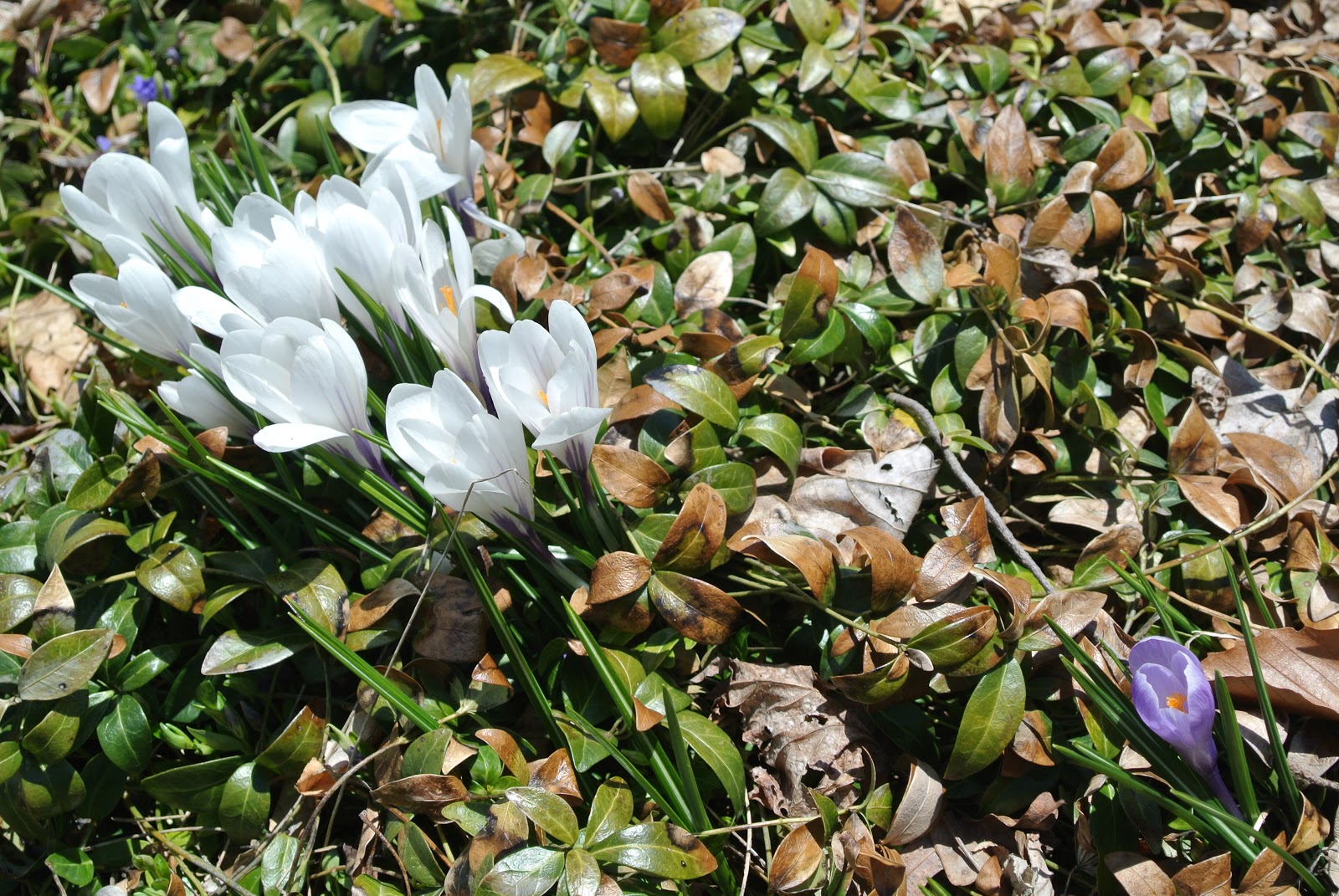
with yellow crocus


hothouse primrose, pansy and johnny jump-ups

the first daffodil ... with crocus


scilla


hyacinth in bud and peony poking up

grape hyacinth in bud


andromeda


forsythia